Episode 29: The Architecture of Human Behavior: Inside The Venus Fly Trap with Dr. Stephan Paul Edwards
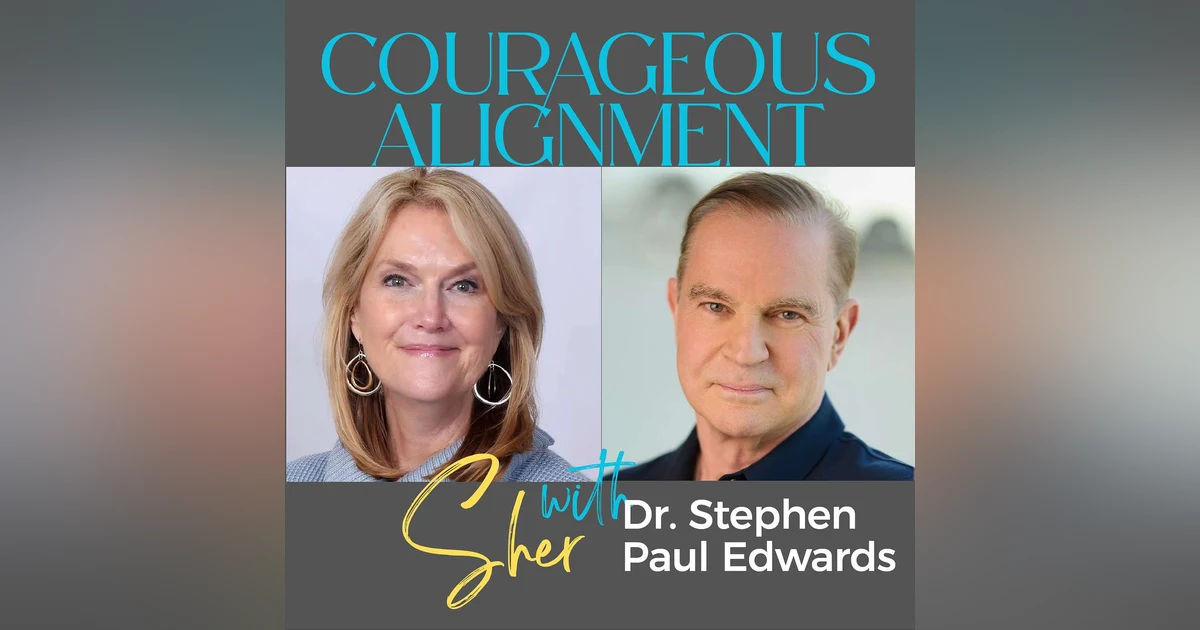
In this episode of the Courageous Alignment Podcast, host Sher engages in a profound conversation with Dr. Stephen Paul Edwards about the intricate patterns of human behavior, emotional dynamics, and the journey of self-awareness. They explore how childhood experiences shape our perceptions and relationships, the importance of recognizing toxic dynamics, and the transformative power of vulnerability and kindness. Dr. Edwards emphasizes that awareness is key to breaking free f...


In this episode of the Courageous Alignment Podcast, host Sher engages in a profound conversation with Dr. Stephen Paul Edwards about the intricate patterns of human behavior, emotional dynamics, and the journey of self-awareness. They explore how childhood experiences shape our perceptions and relationships, the importance of recognizing toxic dynamics, and the transformative power of vulnerability and kindness. Dr. Edwards emphasizes that awareness is key to breaking free from negative patterns and understanding that our experiences, even painful ones, happen for our growth and learning. In this conversation, Dr. Stephen Paul Edwards explores the themes of self-worth, intuition, and the complexities of love and emotional wounds. He emphasizes the importance of setting personal boundaries, recognizing one's own potential, and the role of intuition in navigating relationships. The discussion delves into the journey of self-discovery, the impact of emotional clarity, and the lessons learned from love and loss, ultimately highlighting the intricate dynamics of human behavior and emotional patterns. In this conversation, Dr. Stephen Paul Edwards delves into the intricate relationship between the heart and mind, emphasizing the importance of vulnerability and authenticity in personal growth. He shares his journey of self-discovery, the challenges of navigating toxic relationships, and the transformative power of understanding that life events happen for us, not to us. The discussion highlights the significance of awareness, emotional healing, and the courage to embrace both light and darkness within ourselves.
GUEST: vft23.com
HOST: Retreats
SPEAKER_01
Welcome back to Courageous Alignment Podcast, the space where truth isn't just spoken, it's remembered. Where we explore the patterns, beliefs, and emotional landscapes that quietly shape our lives until we finally begin to see them clearly. I'm your host, Cher, and today's conversation is one I've been looking forward to. Because some stories aren't just stories, they're mirrors. Some books aren't just books, they're maps. And the Venus flytrap is one of those maps. My guest, Dr. Stephen Paul Edwards, takes us beyond the surface of toxic dynamics and into the subtle emotional shifts, internal conflicts, and behavioral patterns that influence so many of our choices. This isn't a conversation about blame or dysfunction. It's a conversation about awareness, about power, about reinvention. It's about what happens when we finally become conscious of patterns that have been directing our lives all along. Steven, thank you for being here with us on Courageous Alignment.
SPEAKER_00
I'm very happy to be here, Sean. I mean, you're talking my language, right? In fact, you pretty much covered everything I do. So let's just call it a quits and let's go for a drink. No, so yes, we're gonna have a great time. We've been having a great time already, right?
SPEAKER_01
Before we jump into your book, I'm curious about you. So, what is the earliest memory you have recognizing a pattern in human behavior, something subtle that others may not have seen?
SPEAKER_00
Well, you know, I I when I was a kid, because you had to, I had to become conscious of the patterns of my parents to protect myself. Um, and I think most people could relate to that. You know, I mean, you know, when I say I had a traumatic childhood, most people go, yeah, me too. We all did, right? At some level, right? We just don't know that the other kids are going through, right? Because it's not like you go to school and say, hey guys, come over here. Are you having an are you having a traumatic time too? Me too, right? We just don't get into that. You don't talk about it. You know, partly because you'd feel like an idiot, partly because you're probably a little bit ashamed, right? Because you think they're doing great and you don't want people to feel sorry for you. So we go around thinking that everybody else is living a perfect life and we're not, which makes us feel even worse about ourselves. So I had to become conscious of even sounds they would make the sound of them walking upstairs, how that would sound, how they would sound when they were talking to each other when they got home, um, and the questions they would ask, right? If I knew where that was going, I had to understand where that was going before I answered the question. Um I had to understand the manipulation and what the things they would say to me really meant. I had to learn that really quickly. So for example, we used to have, and I don't know if you had that this when you were a kid, but we used to have an ice cream van that came around the uh the streets where we lived. It's a little van with uh the side window used to open up and an ice cream cone on the top with an ice cream, and they used to play the music so all the kids you know would come running out and get an ice cream. So my parents would say to me, because they didn't want to buy me an ice cream, they'd say, You don't want an ice cream, do you, Stephen? Which was code for, you're not getting an ice cream, right? I mean, what are you gonna say? No, yeah, definitely want ice cream. Get your ass up, get outside and buy me an ice cream you're not gonna say that, right? So they basically told you, you're not getting an ice cream. So you had to be able to understand that and and not, you know, defy it, because if you did, the consequences would be a lot worse than not getting an ice cream. Yeah, so I think even from a kid, maybe, and you just made me think of that, right? I'd never really thought about it that way before. Um, but that's what has always made me want to understand human behavior. Uh, maybe because it was a protection mechanism, you know?
SPEAKER_01
Awareness is expensive. What did you have to lose, unlearn, or outgrow to become the man who could write the Venus flytrap?
SPEAKER_00
Man, a lot of shit, right? So yeah, it wasn't an easy experience. It was painful. And that and that's my goal is to try, well, one of them, you know, one of one of my focuses is to try and make the transformation a little bit easier than it was for me. And I think we all want to do that, right? We've all had experiences that we've been through. And when we when we figure out how to use them to help other people, the trauma really goes away to a large extent. I mean, there are still wounds there, but you know, now you know it's actually doing something worthwhile. When you're just holding on to it and not talking about it and not sharing it, it's just more painful. So eventually you come to the realization, well I did, that vulnerability is not a weakness. It's a power. It's a power and you know, authenticity. Same, you know, if you're being who you really are and you'd be prepared to be vulnerable, you got nothing to worry about, really, you know. So if you what do they call it, spill the tea, right? You know, if you spill the tea, you know, no one could really use it against you anymore. I saw I wrote stuff in the book and people going, what the hell are you thinking? Why would you tell people when you're in school, all the guys used to tease you because you they'd say you had a small dick? I mean, right? I go, well, you know, what are you gonna do? Um but what I came to understand later in life, unfortunately, too much later, that I try and help people understand is that nothing happens to you. It all happens for you. Now, you know, as a kid, you're not gonna figure that out, right? You're just like you feel like a victim. And because in a way you really are. Not in a way you are, because you don't have any choices that you do when you're older. And so that is when these patterns, and you like to talk about patterns. I talk about patterns all the time. I even say to people, listen, you don't have a relationship problem. You have a pattern problem. All we've got to do is figure out where we create the pattern, interrupt the pattern, put a new pattern in place, and we're good to go. So, you know, these patterns are created when we're children. But later on in life, we do have a choice, but we don't realize we have a choice. So I'll give you a quick analogy here. In India, when an elephant is born, a baby elephant, the elephant's tied to a tree using a rope, right? But and it tries to get through, but it's a bigger, but it can't. So then later in life, when they tie it to the tree, they use the same rope. Well, the the elephant could easily tear that rope away from the tree and run away, but it doesn't. Because it's been proven to the elephant, and now it believes it, that it can't pull away from the tree. And I think that relates to us in a lot of ways, as we get later in life, we have the power to take our power back. We have the ability to take our power back, but we don't believe it. So a woman grows up and she's told when she was a child she's not pretty. That can stay with her. She grows into this beautiful freaking woman, but she still believes she's not pretty. Because she was told that so many times that those people that told her didn't need to say anymore, she's saying it in her head, right? All the guys are going, you're beautiful, you're gorgeous, but she doesn't feel like it. You know, even Tomaz in the book, who is my partner of crime, um, who is amazing. She was amazing. And I had an amazing time and a tough time and a traumatic time. But she was brilliant. And she was obviously very beautiful. She's a former freaking supermodel. I mean, it doesn't get any more beautiful than that. And we'd be in the bathroom getting ready, and she would say things like, Do you think I'm pretty? I don't feel I don't feel like I'm good enough. You know what I mean? I'm like, and I'm thinking, please don't say that in front of another woman. They'll kill you, right? They would die to look like you do. And I would say that to her, and she'd but it didn't matter. It's how she felt of what she'd been told as a little girl that she'd carried forward with her in her life. So we carry these things, you know, and I carry the things uh for me when I was a child where I didn't feel good enough, like having a small dick, right? Or um another thing when I was, you know, at seven, six, seven years of age, I had to bang my head on the pillow to get to sleep till I was exhausted. I had to back literally, right? So there was inside me the anger that a little boy I was carrying because I felt like it was in a straitjacket. I couldn't talk, it was, you know, I couldn't have an opinion. I felt controlled and I felt manipulated and I was being gaslighted. So how else you're gonna feel, and so that becomes tremendously frustrating. And so in that situation with me, it overwhelmed me. I'd become overwhelmed. I didn't know what to do, I didn't feel like I could do anything. So all I wanted to do was run away. I wanted to run away from home. And I did. I ran away eight times, but I wasn't very good at it, and they kept catching me. So I finally was able to get out of the house and away from home when I was 16. But you see, I didn't stop running. I had to keep running, keep running away until it I wasn't running away from a house, I was running away from myself. I was running away from my past that I didn't want to look at because it was too painful. And the irony is there's a perfect metaphor here that across the street from where we lived, there was this little dog, it was a terrier, right? But he had a Napoleon syndrome because he just thought he could just kill every, you know, beat every dog up in the street, no matter how big they were, he was gonna show them how tough he was. And so when cars used to drive by, he used to chase after the cars, right? Now the car was going down the street anyway, but he thought the car was running away from him. So he's like, you know, got that one right, showed that one to his boss, right? So anyway, one day he's chasing after this car, and for whatever reason, the car stopped really quick. And so he ran into the back of the car and he yelped and he was in pain, and then he started running in the opposite direction. What was he running from? He was running from the pain, and he thought if he ran fast enough, he'd run faster than the pain. And that was a perfect metaphor for me. I was just running away, and I thought if I ran fast enough and hard enough, I could get away from the pain. So I just leaned throwing myself into whatever it was I was doing because it was a distraction, it was a way to distract myself from my past. So that had advantages and disadvantages. It caused me not to look at my past, right? And it caused me to be successful at what I was doing. But it wasn't real. What do I mean by that? Well, real success comes from within. We know that, right? Now you can will yourself on the world, on the outside world, but what really goes on outside of you, the mirror, as you like to talk about, which everything is a mirror, right? That's not a mirror. What you've done is you've pushed and forced your will to expand. Belief is like a rubber band. You can stretch it so far, but eventually it's gonna snap back when you stop forcing your will on reality. Now, to force your will on reality is freaking exhausting, right? So, me, I was so intense. You know, I'm going, I'm working like 14, 16 hours a day. You can't keep that up. You know, and I'm working every day because I'm lost in this, I'm distracted, it feels good. And then suddenly it all just implodes because you're exhausted and it all comes crashing down, and now you really see the reflection of you, but you don't see it. What are you gonna do? You know, the CNT go, okay, I'm gonna do it over here, right? So it's gonna be this thing that's gonna make me happy. And you know, as we all know, nothing outside of you is ever gonna make you fulfilled or happy. And so you just kept going around the same pattern. And as you say, it's a pattern until you really look at it, you go into your past and find out where you created it. I mean, it's usually or almost always in your childhood, not always, but it is usually, and you go look at it and then when you look at it from that perspective, like if you can get a beautiful woman to go back and look at her childhood and say, now, if someone said to you that you're ugly or you're not pretty, does that make any sense? And they go, Well, no. There you go. So now we've found it's not the truth anymore.
SPEAKER_01
You write about emotional intensity shaping decision making.
SPEAKER_00
Yeah.
SPEAKER_01
Was there a moment in your own life when emotion nearly hijacked your clarity?
SPEAKER_00
All the time. I mean, I was pretty much hijacked for three years by my emotional intensity. Um at least in that relationship. And before, right? So yeah. And I, you know, I mean, I can't speak for everybody. Um it I think it happens to all of us at different times because we are emotional beings. Yeah. We're not, you know, we we try and shut down emotions to the best of our ability, emotions that scare us, um, emotions that we don't want to feel. But all that happens then is that energy, because emotion is energy in motion, emotion, it gets hurled up in the cells of our being, our body, and we are light vibrating, energy vibrating. And if we have heavy energy, lower energy, lower vibrational energy like anger and gel, all these things, it slows down our vibration. And that creates an electromagnetic field of energy that is gonna attract the energy that resonates with that into our lives. We can't help it. There's no way around it. So, you know, when people say, Well, you know, oh god, I got out of that relationship, it's terrible. You know, I'm not gonna date for a year. I'm gonna, you know, heal, right? You know what I'm gonna say. And then what happens? Nothing. They date the same body, they meet the same person, a different body, and they go, How the hell did I pull that off? How is that even possible? And you're going, it's impossible to do anything else.
SPEAKER_01
Nothing changes, yeah. You write that toxic dynamics often begin with small changes and subtle shifts. What is the most dangerous shift people miss in the beginning?
SPEAKER_00
It's a great question. Well, at first it it starts out innocuously, you don't notice it. So you've got to become very aware if you stop doing the things that make you who you are, you start hanging out with your girlfriends. You stop if you go to the gym, you stop going to the gym. And it's not just like you decide, I'm not gonna go to the gym anymore, I'm not gonna hang out with my girlfriends, it's the other person that will say, I don't want you to go tonight, so I want you to stay here. Or if the woman will say it to the guy, right? Which happened to me, and you want to please them, right? But you slip, you're letting yourself slip. And eventually they're gonna completely isolate you. Usually, not always again, but usually in the relationship, there's a giver and a taker. There's the person that wants to do everything they can for their partner, but they get to the point where they start saying, Whatever I do is never good enough. It's never good enough for you, right? Because it isn't. And the other the other person's thinking they're not giving enough. So you've got to be careful and notice if are you a giver? You know, are you an empath? Are you a giver? Are you the person that always wants to help everybody and put yourself last? That's not good. And you're more likely to give yourself away than someone who has set good boundaries and say, look, I'm not gonna not go see my friends, I'm not gonna not go see my family, I'm not gonna not go to the gym, read, or whatever it is that makes you who you are, you know, meditate, all those things. But they will work hard to try and stop you. Not directly, indirectly. Right. I don't think your friends like. Um, and if that doesn't work, it'll escalate until the point is, you know, I think your girlfriend's hitting on me. Do you know what I mean? It's gonna escalate. Yeah. And then now now she's in doubt, right? Really? You know what I mean?
SPEAKER_01
Yes.
SPEAKER_00
Right. So just be aware, you know. I mean, you've probably known that friend for 20 years, 10 years. They're probably not gonna be doing that. Very unlikely, right? Yes. So, but doesn't mean you don't necessarily take any notice, but just be aware. But don't start not seeing your friends. Don't start not going, you know, the same things. You do the things that make you who you are. And it doesn't happen overnight. So you've got to be conscious. I haven't been to the gym in a week. I haven't seen my girlfriends in two weeks, right? That's not me.
SPEAKER_01
Many people assume toxic relationships happen to naive people, but your work suggests otherwise. What's the most intelligent reason someone stays in a situation they know isn't healthy?
SPEAKER_00
Well, intelligence is not necessarily all-encompassing. So you can be intelligent in certain areas of your life and very unintelligent in relationships. Right. So um, so why do we make unintelligent decisions? Well, we talked about in the beginning, emotion, right? Emotion. We get caught, we get hooked. And so we all have flaws in us, which is fine. Until they become so destructive, we need to really address them. And so, what a first of all is a gift. It's not happening to you, it's happening for you. That's a pretty controversial thing to say.
SPEAKER_01
And there's probably It depends on how much of your life it sucks up.
SPEAKER_00
There's probably probably a bunch of women throwing their freaking shoe at the freaking, what the hell does he know? I don't need a guy telling me that he wasn't there. I got the receipts, right? That fucking idiot beat the shit out of me, whatever it is. You know, I'm not buying that. Click. So anyway, hold tight, right? I'm not saying they didn't do those things, not saying that at all. What I am saying is we can't change that. It's happened. And if we decide to believe, it's a choice that it happened to us or it happened to me, now you got a wound. Now you got something you gotta heal. Whereas if you believe, now this is not an easy belief to adopt, that it happened for you, it's gonna be a challenge. So put your shoe back on, you're gonna be fine, keep the radio on, all right. If you believe it happened for you, and you commit to that belief. I mean, you can say that, but not really believe it, right? But if you commit to that, you will find how it happened for you. What will you find, sure? You talked about it at the beginning, the mirror. It's all a mirror, right? It's just that other person is reflecting you back to you. And what a lot of people will say is that's bullshit. I would never do that any to I would never abuse anybody else, verbally, emotionally, in any way. I've never done that, I never will. No, but you allowed them to do it to you.
SPEAKER_01
It's the boundaries, understanding where they didn't form.
unknown
Yeah.
SPEAKER_00
So you wouldn't do it to anybody else, you wouldn't stand and watch somebody else have that done to them. So why are you allowing it to be done to you? So the mirror is you need to stop allowing people treat you in any other way than you would treat them. You treat people with respect, you you treat people with kindness. Does kindness is not a weakness, kindness is a strength. Right? Absolutely. When you can be kind to yourself and you can say, I'm not gonna allow anybody to do that to me. I deserve better than that. I can't make excuses for their behavior. Their behavior is their behavior. I can't live in the hope that I'm gonna change them. That's a lot less likely to happen when you're putting up with it. Now they've got no incentive anyway. You know what I mean? So it's a mirror in some way, shape, or form. Yeah, people, you know, you can confuse there's different types of mirrors. So people can quickly and understand jump to, well, uh it's not a mirror because I wouldn't do that. No, but it's mirroring a part of yourself that you've given away in some way, shape, or it's mirroring a part of yourself that you've judged. Or it's mirroring a part of yourself that's part of your power that you've denied. You know, when we're attracted to someone because you know, and men and women are attracted usually, and I say I hate to generalize, which is a good thing to say before I generalize. Um but there are we are we're different, right? We're a different species of the human conditioner. And so we tend to be drawn to different things. But whatever it is you're drawn to in somebody else, it's a potential that lies within you that you just need to actualize because it's never going to be actualized by you having adoration for someone who is expressing a part of yourself that you're not. The way that we deal with that is to say, Well, I can be that confident. I know I can. Right? You know? I I can be um whatever it is, whatever the whatever the characteristic is, is a characteristic that lies within you. Now, people say, Well, I want to be a basketball player, but I'm 55. I don't know if that's gonna happen. I'm not saying that. There are there are certain physical realities that we have to deal with. But um yeah, mirrors, you know, mirrors, mirrors, mirrors. Yeah, for sure.
SPEAKER_01
Yeah. You write about clarity can become replaced by emotion. What does that moment actually feel like from inside before someone realizes what's happening?
SPEAKER_00
Hmm. That's a good question, too. Because there is a feeling. There is a feeling. Um, but I just want to go back to say you can have clarity and emotion, but so emotion can override the clarity that you can see. It but your emotion is so you know you you so strong. This is the guy for me, or this is the woman for me. Happen to me. Let me give you an example here, right? Because we have intuition, and people say, I don't have intuition. Yes, you do. You're just not aware of it, but you do. We all do. But you haven't used it if you don't think you got it and you're not noticing it. It's like uh, you know, I say to people, listen, if I gave you a Stradivarius violin right now and you've never played the violin and you start trying to play it, it's probably gonna sound pretty bad. You're not gonna get a lot of really good music out of it, and there's certainly nobody going to the opera house to hear you play. But if you stick with it and you practice it, and you start to learn the subtlety of the movement of the bow across the strings, and you learn how to use those strings to make a beautiful sound. It's the same thing with your intuition. It's very fine, it's very gentle, it's very, you know, you need to learn how to play the strings of your intuition. But when you do, now you can begin to trust it. Now you know the subtleties of your intuition and of your feelings, right? Um so you can use them to guide you through life. And I believe that that's where we're heading. We're heading towards going inwards. I mean, what can you get in the external world now? Nothing. You simply can't get certainty out there, right?
SPEAKER_01
That's right.
SPEAKER_00
It's just ridiculous, right? You say you can't go on Facebook and get certainty, can you? You know, you get a million different uh facades of reality. None of them are probably true. And so what I believe is happening, because I think everything does happen for a reason, I think we're being pushed inward. We're having to go inside to find the truth. That's right, I agree. You know what I mean? And so, you know, you gotta you gotta tune into your intuition, right? But if we do that, life becomes easier. Um so anyway, yeah, I you know, so going back to the little story I was gonna tell you. So when we first so I'm going through my fourth divorce, right? Doing great. I'm on the road to the world record. Anyway, I uh I go through my fourth divorce, which is insane in itself, right? Uh and uh this is what tended to happen. My whole life would implode, right? Uh-huh. Because of me, not anybody else, but I I was a victim. So, you know, why does this keep happening to me, right? These people do this or these people do that. Anyway, so I'm going through my fourth divorce. I've got, I'm burned out on my speaking and going all over the world and doing that. I'm like, this can't do it anymore. I'm going, I'm seven days a week, getting up at five o'clock in the morning and meditating and doing all that. And none of that stuff is working because I'm so freaking exhausted and stressed out, right? So anyway, I'm now in this uh this burnout stage, divorcing my wife, living alone in a mansion, staying in bed like 23 out of 24 hours a day. I only get out of bed to go to the kitchen and get something, right? So um I might you might say I was burned out or hit rock bottom, whatever you want to call it. And that is the that is the time when the universe is gonna step in because it abores a void, right? And so um finally my friend Jerry, who's in the book, he says, dude, you gotta get out of bed. And you know that. You gotta start doing something. He goes, When do you start dating? And I go, dating? What are you crazy? I'm gone all the time, blah, blah, blah. But you know how these things get seed planted, right? So I'm in bed and I'm thinking, yeah, I get on the internet and I start looking around on websites. And before I know it, I'm in the website, I'm looking around. And it's an international website, and she's on there, and I'm like, holy shit, she's amazing. She's gorgeous. But I'm thinking, you know, I got no chance. You know, the little child, little kids coming out there, you know, it's like looking at the girl you like across the canteen, and you're all nervous and you're not just looking nuts. You don't know what to say, right? It's exciting but terrifying at the same time.
SPEAKER_02
Sure.
SPEAKER_00
So finally, I say to myself, well, you know, she's not, she's not gonna know who the hell I am, so I've got nothing to lose. I can hide behind the mystery, right? So I send her a text uh through the website, and of course it's way too long. Um Jerry looks at it and goes, dude, she probably started reading after the first paragraph, right? So anyway, so so anyway, she takes it back like I don't know, three days later, very nonchalant, three lines, and I go, She liked me, right? Nothing in those three lines said anything about her liking me, but it was like pouring gasoline on fire, right? Right. So I got her to agree. I say I got her to agree to go on a date. Well, let me let me qualify that because it was really pathetic. She actually lived down the road from me. Oh. Even though this is a freaking and what are the chances? Well, obviously the chances were high because it was meant to happen, right? So I said to her, so I got it, finally I got her to agree to go for a coffee with me. I mean, big deal, right? Go for a coffee. But I was willing to take whatever I could get. So she agreed to go with a coffee. Yes, right. The next day, she canceled. I'm like, no, man, you gotta be kidding me. But now I'm committed. Now, now I gotta find a way, right? I can't lose here. So then I get her to go on a date. But of course, at this point, I'm thinking, I gotta tie this freaking date down. She, I can't let her cancel again. So I'm thinking of all these things that I could do to tie the date down. And so what I thought, I'll buy her some flowers and I'll kind of, you know, round, round on a roundabout way, let her know I'm gonna buy her flowers. You can't cancel on a guy when he's gonna buy you flowers. This is my this is my thought pattern, right? So I text her and I say, I say, yeah, so what's your favorite flower? And she goes, she takes it back, bird of paradise. And you know, I like to joke around, so I go, nuh-uh. Mine too. I said, but here's the thing, it's a bit expensive, so what's your second favorite? I mean, who says that? Nobody, right? But she takes it back instantly. Venus fly track. Whoa, right? And so what happened? My intuition went, that's dangerous. My intuition was ringing a bell, right? Hello. And I tell people, look, people tell you who they are in the first few minutes of you meeting them. But what happens is very often our ego overrides it, right? And I'm still thinking she's freaking cute, beautiful, sexy. How bad can it be?
SPEAKER_01
Right.
SPEAKER_00
I didn't know how bad it could be at that point. And I said, you know, so your intuition, the intuition saying she's freaking dangerous. And I go, yeah, but you know, I like a bit of danger. You can talk yourself into anything, right? If your emotion is strong enough, right? Which is what you're saying, right? You know, that's where the emotion completely overrode the clarity. It was clear as day. You know what I mean? Yeah, but my emotion overrode it.
SPEAKER_01
So in the Venus flytrap, Tomaz represents emotional reality while you represent awareness. What part of Tomaz still lives in you, and what part continues to observe him?
SPEAKER_00
Well, a big part of her, right? So um I loved her. I mean, I really did. And I still love her. She's never getting back in my life again. You know, you can love someone from afar. You can love because I'm so grateful to her for coming into my life and being a master teacher for me. You see, this is my belief, and you know, beliefs are not necessarily true. We make them all up. But this is the belief, this is what I believe. I believe that in essence we are all spirits and in our natural state, we are all fully enlightened and that we come into this existence and decide that in order to have an experience here, we've got to forget who we really are. Because if we came into this life as a fully enlightened being, what's the point? So we come in at different stages of remembrance, but we also come in here into this life with certain contracts that we're gonna fulfill. And I believe that she chose to come into this life for me and others to play this role to be a master teacher. And for that, I'm eternally grateful uh and love her for that.
SPEAKER_01
How long did it take you to get from where you were then to shift that belief into what you believe now to move forward?
SPEAKER_00
I did believe that all the time. I I I knew those things, and then I didn't just learn those things from being with her. I I knew those things, and I knew she was a soul and a spirit coming into my life, and I knew it wouldn't last forever. I knew that because it was impossible, it was untenable. There's just no way you could live like that. I lived like that for quite a long time, but you just couldn't keep it going. Um because you'd be dead. Um I mean the the speed and pace of that alone of what was going on in our lives was just you know, because we're both intense people and we're both crazy. And I kind of mean that literally, right? You know, if you read the book, it talks about I was in an asylum when I was 16, right? I mean, literally, in an ascent asylum. I had electric convulsive therapy and all kinds of things.
SPEAKER_01
Wow.
SPEAKER_00
Yeah, yeah.
SPEAKER_01
Wow.
SPEAKER_00
And so, but here's the irony, sure. She was in an asylum when she was a young teenager, too. So we both had so many mirrors, right? So many how interesting. Yeah, and uh incredible. She had a lot of similarities in her upbringing, in her relationships with her parents, right? Um, so many things that obviously created the same energy. So we were drawn together because of that, and we were we were playing out with each other all these traumas, right? And we were both very strong people. Uh, you know, she she grew up in a her father's a billionaire, right? So you can imagine the wealth that she grew up in, right? It's just, it's just not, it's in a different reality, right? So she grew up knowing she could get whatever she wanted. And so she now it wasn't so this is you gotta understand. So it wasn't that she was she just come to expect it, right? And so it was just part of her demeanor. And so what happens if you believe you're you're gonna get something, you'll get it, right? And she used to do all kinds of amazing things, and I'm going, how the hell did she pull that off, right? So she was used to having whatever she wanted. Now, I didn't, I wasn't born into that kind of wealth, but I'd worked my ass off, right? And been intense and I'd been successful. So now I'm living in this, you know, for me, I mean, to in comparison to her and her family, it was nothing. I mean, her dad had like three planes, right? But for me, it was a big deal. I mean, living in a mansion and I and I'm making you know millions of dollars a year. But I'd really fought hard to do that. And I I wasn't I'm not the kind of guy that is gonna make it easy for someone because nobody made it easy for me, but because it wasn't easy for me, it built resilience in me. Right. So she just thought that she was gonna like sit around and do nothing, party when I wasn't home, me work my ass off, and I'm like, I'm not having it, right? That's not gonna work that way. You gotta get a job. She's like, a job, are you crazy? I'm not gonna get a job. So we had this thing going on, right? This we butt heads on stuff. So she would steal money off me. I mean, not a lot of money, but she'd steal it out of my bag, she'd do whatever she had to do, because I'm not getting a job. So there. She used to say that to me sometimes. She goes, Why do I have to get a job? What's the point? You know what I mean? And like I'd be going, I even talk to this kind of mindset, you know what I mean? It's just completely a different world. Right. So, because I'd had to pull myself up, she just had to show up, and then she's so beautiful. I mean, she she could get a guy round her finger in, and I I'm not just joking, because she did it a few times, she could get a guy wrapped around her finger in minutes. Uh, so that was an interesting uh dynamic, right? That I'm constantly and and and she doesn't, as far as she's concerned, she's never gonna give off alcohol, she's never gonna wanna, you know, get off alcohol addiction, never gonna want to get off drugs, never want to stop being a sex addict. And that's just the way it is. So the reason, though, for that, which I didn't find out till later, is that she has a disease which is incurable. And I didn't know at the beginning, found out later, to the point where she cannot deal with reality, literally. So for her to give up those substances, she would rather die. Because it's the only way she can feel, right? Yeah, it's the only way she can feel. And people might people would say, Well, then good, now you know you gotta go. But it in actual fact, it makes you empathize even more, right? You know, I gotta stay because you know I gotta do the best I can do. And I even read about it, and it said, it's and and you read what you want to read, right? So it said it's it's treatable. Well, what did they say in my mind? It's curable, but it isn't. It isn't, you know? Yeah, and so there's some deep wounding. And so it's you know, it's a beautiful love story, it's hilarious, it's definitely toxic, it's definitely romantic, it's definitely erotic, but it's also tragic.
SPEAKER_01
If you were writing Tomaz today, what would you understand now that you couldn't see then?
SPEAKER_00
Well, that's one of them, right? Uh uh I don't know if I really, really thought about it that at the time, but obviously, just like like any of us, she's just looking for love, right? And it's very hard for her to feel loved. Okay, say it's hard for all of us, all right. So let me explain it is hard for all of us, right? So for her, she was just a rebellious kid anyway. I mean, her father told me she did all kinds of terrible things when she was young. He never told me why, and I probably didn't I wouldn't have asked him anyway, and I don't want to know, but he put her in an asylum. So it was him who put her in the Hassain asylum. So here you are. Here she is, this young girl who is already angry at her father because her father's very analytical, he has no emotion. So that's hard for a girl because she can't reach him emotionally, you know what I mean? And anytime she tried to get an emotion, he would shut her down. And then he puts her in asylum and she can't get out. So for her, that meant she was unlovable. Because if your dad can't love you, what man is ever gonna love you? And then she grows into this stunning young woman, the men around are like flies, being a flytrap, right? Uh, and all they ever seem to want from her is sex. And as that reinforces that belief, that becomes more and more of a reality because she pushes them away because she's angry with them, because she's angry with her father. And so that was her experience of men in her life. So she set out to prove to men that she was smarter than them and take the most important thing to them away, which seemed to be their money, as it was with her father. And so she really was a Venus flytrap, and I was the fly.
SPEAKER_01
Yeah. We've been exploring the mechanics of human behavior and the emotional patterns. I'd like to go a level deeper now, because woven through your work is a larger conversation about wisdom, intuition, and the relationship between the heart and the mind. The UPIC elders described ours as a reverse society where the mind often silences the heart. What belief did you have to reverse in yourself, to begin living more from your heart?
SPEAKER_00
Well, I wish I could say I could tell you a particular point. My mom always said that about me. I think it was an innate in me, you know. I think that is just one of those innate um maybe not. I mean, maybe it was because I didn't feel loved as a child, you know? Um, so that made me an empath, right? Empathic. And maybe I was born with that. I can't tell you, honestly. I don't know. I don't know when if there was a particular shift in there. Um, but I've always been, I've always, well, here's I definitely know from my child that I've always sided with the underdog. I I hated bullies. Uh I, you know, the weakest kids would find their way to me and I'd ended up fighting for them, which wasn't a good thing and it wasn't helpful. But I didn't know that then. I I thought that was the right thing to do. Um, so that's part of my uh, you know, again, you being an empath is a gift and a curse, right? Right. You know, and that's a good way to find yourself losing yourself in a relationship. And so at some point in your life you've got to balance that out. And I realized that. I I realized that after the fact with Tomas, because then I started to see I'd done that there, and then other places I'd done it, right? So then you start to see the mirror going through your life, and then you start to get where did it all start and you go back into your childhood. Because I wanted to please my parents. I thought if I pleased them enough, they would give me love, right? But I I was trauma bonded, right? I was trauma bonded from a child. So parents would be stern and harsh, uh, and then give me a little bit of love, and then so you were hopefully you're gonna get that love again soon. And so you just you go through this trauma bond, right? Um so to say, when did I uh so then I so then when you feel that way, you start to find those things in your life that are gonna reinforce that. So I went to work with Tony Robbins for a number of years, which is amazing, right? And then I started to get into more spiritual learnings and teachings. And of course, that's gonna take you to the heart. And that's what I was drawn to, right? That's what I was drawn to. And that's why I got a PhD in spiritual counseling, you know, and and do what I do today. So, and this is why, again, I say to people, look, it it's all happening for you. Now, not to you. Now, it might not, you might not get that right away. It might take you years, right?
SPEAKER_01
Yeah, not when you're in it. Not when you're in it.
SPEAKER_00
Yeah, yeah, it's not realistic, is it, right? And not right after something has happened, you know, you know, it's like someone the guy beats the shit out of you, and then someone says, Well, you know what happened for you. What? You know, we're gonna fucking kill you, right? So, but when things settle down, and I and I I tell a story about this about uh Tamaz and what she did with me, uh, and what she did and how I uh had to transmute the anger that I had when she did it. And it wasn't easy, you know, even with someone who says everything happens for you. We can all be a victim. Things can happen, it's so intense, and this illusion is freaking powerful, right? And so you can anybody can get sucked in, and it's okay, you know, we're gonna be a victim at certain times. It's okay. We just don't want to get stuck there, right? We don't want to be there all our lives or for months, years, right? But a few days, it's okay. You know, we're human, right? Um but you know, even you know, with the things that I've just talked about that were very traumatic as a child, every single one of them at some point in my life has been a gift. A real gift, you know. Um but again, I would just say, look, I'm I'm not saying you're gonna get it right away. You will though, if you're open to it. You know, all those things that have ended up being a gift, I didn't think they were a gift. I hid those things. I was ashamed of those things. I would never tell anybody any of those things. Are you crazy? But what you realize when you don't, you're only living half a life. Right. Because you can never love anybody. You go, why? Well, because you're afraid of them finding something out about you that might make them not love you. And so you're always gonna be scared of that. You're always gonna hold a part of yourself back, even though you don't know it consciously, you are, right? And they can also feel there's a part of you that they don't know. Because they feel it, they feel it, right? It's part of your energy. So when you can let that out, now I would say to people, first of all, don't tell them the shit on the first date, right? That's not what I'm saying. You go too far. No, you don't want to more than you want to be getting married in a month, either. Right. But that can happen when you're so drawn to somebody, you don't lose them. This is the man, a woman of my dreams. I don't want to lose them, right? So we'll move in. Let's just move in. No. So you know, when I I decided to become vulnerable, I put it in a book. I'm not saying do that either, right? But I wanted to just make a point of saying, I gotta be the example. You know, if I can be vulnerable, that and it was freaking scary, don't get me wrong. I'm starting to think, you know, maybe I shouldn't publish this book, right? So um, but if you can be that vulnerable, you realize that it's a power, it's not a weakness, right? Absolutely, yes. And then when you can put it out in the world, the other part of that, sure, and I know you get this too, is that no one can say anything about you. You haven't said anyway. Right. You've got nothing to hide, right? And that is amazing because it gives you- It's a freedom.
SPEAKER_01
It gives you a freedom.
SPEAKER_00
That is exactly what I was you get it.
SPEAKER_01
Yeah. Yeah. Yeah, for sure. You write that this work invites us to accept both of our light and our darkness.
SPEAKER_02
Yeah.
SPEAKER_01
What part of your own darkness did you have to make peace with in order to write this book honestly?
SPEAKER_00
Yeah. Well, my sexuality one. I mean, that's a pretty erotic book. It's pretty explicit. Um, but I just let it out. I mean, I just went back, I went in. I mean, I lived it again, right? I lived it in my own mind and then just put it on paper. I had to uh become humble, right? And to say, Lord, yeah, I had to be become more human. And so not without making excuses for it. I mean, these things happened from when I was a kid. I found things to do that justified it, right? So I'm in the personal and spiritual development arena. And my belief, and seems like a lot of people in that arena, we think we have to be perfect. That we can show our flaws. And that makes it lonely, right?
SPEAKER_01
For sure.
SPEAKER_00
Because I'd be up on stage sometimes for days, and I get off the stage and people say, Wow, man, that is amazing. You've really got your shit together. And I'd be like, that is not me. That's a that's a that's an act, right? That is a show. It's a show. And I'm talking about all these amazing things. If I could do that, I'd already be levitating, right? You can't do all those things, right? Working on me as well. But if you say that, it breaks the it breaks the the um what's the the veil? I don't know. Um maybe that was just my belief, probably, because of my own securities, right? But it stops you being really authentic, you know, it stops you being really you. Uh and now that I can do that in front of a few thousand people, again, that authenticity is not a weakness. Your flaws are not a weakness, they're a power. They're it makes people, it makes you more relatable, right?
SPEAKER_01
It's a medicine.
SPEAKER_00
Yeah, you go. Great word for it. Very good. Yeah.
SPEAKER_01
Yeah. What is the single hardest truth you discovered while writing this book? The one that changed you permanently.
SPEAKER_00
Well, I think those two, probably authenticity and uh vulnerability. You know, they're not a weakness, they're a power, you know. And they give you what you said you hit it right out of the gate. Freedom. The freedom to be who you are. Without living I feel you have to live up to an image or a persona, um, because that makes you feel alone. You know, and that was one of the one of the other reasons I wrote the book is because when you go through these episodes, or if you want to call it a traumatic relationship, I call it a Venus flytrap relationship now, right? If you're gonna go through these things, you feel like nobody understands. And the truth is they don't. Because only you can understand what you are going through because you're going through it. They they're not going through it. You know, they'll say, Well, why don't you just leave? It's not that easy. Not because you couldn't walk out of a door. Well, literally, you could walk out of a door. Why isn't it that easy? Because you're so attached to the feeling of not being good enough, the feeling of not being worthy, the fear of losing someone, abandonment, the fear of trusting in your own decisions, the fear of trusting in the process, the fear of um something happening on on to you untoward, not having the belief, the faith, and the trust that if you make a decision and you are gonna leave, that the universe, God, whatever you want to create it, is going to co-create with you the opportunities. And there will be miracles that will happen. But you got to believe that because it's a shift in your vibration, it's a shift in your energy. But you've got to decide, and you can't be tentative. You can't be, well, I hope it works out. You know, it's not gonna work. Your energy is still doubt, your energy is still fear. So, you know, one of the things I teach now is how to build your identity of who you are, who you want, how you want to show up in the world, right? But the first step, because people always ask this, right? What's the first step on the journey? And the first step is awareness. The first step is the awareness that this is not how you want to be. This is not how you want to show up in the world, this is not how you want to be treated, this is not how you're gonna allow anybody to treat you. And all these things come to your awareness, and then you can figure out how to leave. But you have to build up that resilience, you have to build up that commitment, you have to make a real decision. Because decision means to cut off any other alternative. You are gonna find a way, and a way will show up. I mean, we've all heard stories of you know, women uh with their child is about to get you know run under a car and they stay lift the car up to say that, well, they can't lift that car. It's not even possible. But they did it anyway.
unknown
Yeah.
SPEAKER_01
Was there anything you nearly left out of the book because it felt too vulnerable to share?
SPEAKER_00
Well, I mean, I mean, there are things that happened to me, other things that happened to me were pretty humiliating, but you know, I had to cut it off at the end because it was already 24 chapters long in the first book. And I got another 28 chapters in book two. So but there are mu there are other books that will come out. I had a pretty extraordinary life. I'm gonna tell you that right now. And I had a very extraordinary first uh, you know, when I was at school and then teenage, the teenage life where I got into not just sex and and rock and roll, but drugs and all those kind of things, you know. And then for some reason when I came to America, I I decided to clean it up and turn my life around. But up until then, it had been pretty because I was rebellious, right? You know, I'd had a pretty shitty childhood. And so you go out into the world and we just are drawn. We have to find family. We will find family one way, shape, or form or another, or we'll kill ourselves, right? So I found family as it very often happens with young guys in the wrong place.
SPEAKER_01
Yeah.
SPEAKER_00
And so that sent me on a journey. But that'll be another book. I'll talk about it. So that's gonna be before the Venus flytrap.
SPEAKER_01
Oh, there you go. What relational pattern do you see most often in society right now? One that concerns you because so many people fail to recognize it.
SPEAKER_00
Yeah. Uh, you know, the biggest thing is that people don't know. They don't understand, you know? Um we're all going through stuff, right? We're all going through stuff. And I say to people, listen, a pound of prevention is worth a thousand pounds of cure. Prevention before cure, you know. And people don't want to do that because unconsciously they don't want to face it. They know it's there, you know. They know how they have trouble with their relationships, their family, even their friends. They do and say things they later regret, but then very often don't want to own them because then they're gonna feel like they're stupid or there's something wrong, or you know, and all these kinds of so everybody's doing it in one way, shape, or form or another. And some people to the degree, they just literally don't know they're doing it.
SPEAKER_01
They don't know that they're so deep in their unconscious mind, yeah.
SPEAKER_00
Yeah, they're just venting. They don't mean it. I mean, what's the phrase, you know, we we tend to take it all out on the people we love the most.
SPEAKER_01
It's true. If you could help humanity break one emotional pattern overnight, which one would create the greatest transformation?
SPEAKER_00
Well, as as as as and this is what I say. I say, look, one of the biggest breakthroughs for me that changed my life was uh coming to the understanding and believing that none of it happens to you, it all happens for you. And that changes everything. It changes everything. And I know it's not easy, uh, but I can give you hundreds of examples I don't know about hundreds, but I can give you a lot of examples of people that have been through trauma that you can't even believe but have come through it and seeing the silver lining, how it happened for them. So I'll give you an example, and most of the ladies that are listening to this, and I think even the guys are gonna relate this would be really, really hard to overcome. And you got all the sexual abuse, the physical abuse, you've got all those things. But this lady is from Ireland, and she lives in Ireland, and her daughter used suicide to take her life. She was about eight. I mean, how do you reconcile that as a mother? Yeah. How do you find in that how it happened for you, right? So, first of all, that is not something that is gonna happen overnight, right? Because you've got to go through the grieving process. You know, and a lot of people don't understand that. A lot of people don't understand grief, a lot of people don't understand what how to talk to people that have just lost their partner or a child or something. We're not taught this stuff, right? How to communicate, which we can't, right? It's awful. It's also awful for both sides because then what happens is the person going through grief is left alone because people don't want to go around there, they don't want to they feel uncomfortable, all these kind of things. So, anyway, so she went through a grieving process and she decided to create a foundation in her daughter's name, and what they did is they uh bought a building, uh, created a hotline. The young people, if they felt like they might be thinking of taking their life, or they needed to get away and they needed a safe haven, they could go to this physical place and they would be safe. Well, they saved 15,000 children's lives. So she understood.
SPEAKER_01
Yeah. What a way to find understanding. That's tough. Yeah, but you make your way through it.
SPEAKER_00
Somehow, yeah, somehow we're survivors, and so by taking that ex now, it doesn't mean she wanted a daughter to take her life. That's not the point. Right, right. But she's saying that now she what she realizes she has taken a life. I can't change it. How can I give a positive meaning to that? Well, in her in her name, 15,000 lives.
SPEAKER_01
Yeah. Which is pretty amazing. That's the magic right there.
SPEAKER_02
Yeah.
SPEAKER_01
If someone listening today finds themselves standing at the doorway of a toxic dynamic, not fully in, not fully out, yeah, what is the one sentence you most want them to hear?
SPEAKER_00
Don't go. I'm just kidding. Um just um because here's the thing, you know, anybody looking in that situation objectively with me would have said, Don't do it. Get out of it. However, it was what I needed. It was what I needed. So sometimes we want to p pull people out of things, and it's not the right thing. Because here's the thing, if we pull them out too soon, what do you think is gonna happen?
SPEAKER_01
They're gonna go back. They're gonna go back because they weren't done yet. Yeah, exactly. They didn't get the full the full teaching.
SPEAKER_00
Yeah, exactly. They didn't get a chance, you took it away from them, right? So, and that doesn't mean you don't say anything. That's okay too. Because maybe you're gonna say the right thing, they're not gonna go, and they don't need to go through it. I'm not saying don't give them the benefit of your wisdom and your love and your caring. Just know if they don't and they do go in or they go back, it's okay. And just be there for them when they are finally ready to get out of it. Because they're gonna need you. Right.
SPEAKER_01
Stephen, thank you. Not only for the work you've created, but for the honesty, vulnerability, and the depth that you brought to this conversation. What you've shared today reminds us that awareness is not a destination, it's a practice, that reinvention is not a luxury, it's a responsibility. When we finally allow the soul to speak, it often reveals the truth the mind has been struggling to understand all along.
SPEAKER_00
That's a beautiful beautifully put. You're a wordsmith, you know that, right? Thank you. I uh, you know, these questions, which I wasn't looking at, but I read them and I'm like, these are brilliant. I'm gonna keep these. So so you definitely have a gift. You have uh you're very deep. So I would imagine, and I'm guessing, I think you're probably an empath, right? So you're very studying people, yes. That's powerful.
SPEAKER_01
Thank you so much. It's been a pleasure to chat with you and to understand a little bit more about your work, what you're trying to accomplish, and thank you for all that you're doing and sharing with the world.
SPEAKER_00
All right. Well, thank you for giving me a platform and for others too. You're doing amazing, incredibly important work too. So thank you for having me on. I appreciate it.
SPEAKER_01
Oh, thank you, Stephen. Have a wonderful weekend.
SPEAKER_00
You too.
SPEAKER_01
Bye-bye.
SPEAKER_00
Bye-bye now.
SPEAKER_01
To everyone listening, if today's conversation stirred something within you, if you recognized yourself in these patterns or felt called toward healing and deeper alignment, I'd love to extend an invitation. This fall I'll be hosting Moonlight and Medicine, a Chiron retreat for soul-level renewal in Scottsdale, Arizona. It will be Thursday, September 24th through Sunday, September 27th. This intimate experience is designed for deep breast, emotional release, healing, and personal transformation, with space for only 12 participants. To learn more or reserve your place, please visit courageousalignment3.com or call 262-227-7009. Registration closes September 10th. If your heart is whispering that it's time to heal, perhaps this is your invitation. If today's episode resonated, please follow and continue to tune in and share it with someone who is ready to step into their truth. You can also find more information on services and upcoming retreats at www.courageousalignment3.com and on Instagram at courageousalignment3.com. For the rest of the summer, new episodes will drop every other week to help this work breathe, deepen, and evolve. Remember when you are truly in alignment with your soul, the heart will follow. Your mind will become its wingman. Life will become much easier. Courageous Alignment Podcast is where it all comes together. I'm looking forward to spending more time with you real soon. I'll see you then.

